PA FINGERS (2nd-5th)
Posteroanterior projection for index, middle, ring, and little fingers
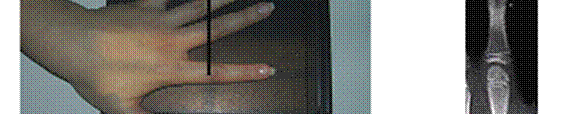
Exposure Factors
Note: Adjust mAs according to the thickness of the specific finger to be evaluated.
Visible Anatomical Structures
The following should be clearly observed:
- Distal, middle, and proximal phalanges of the studied finger.
- Distal portion of the metacarpal corresponding to the finger.
- Interphalangeal joints (distal and proximal) and metacarpophalangeal joint.
- Surrounding soft tissues and tuft of the distal phalanx.
Plate Size and Orientation
The plate is usually divided to include PA, Oblique, and Lateral views on the same receptor.
Patient Positioning
Central Ray Specifications
Point of Entry: Proximal Interphalangeal (PIP) joint of the studied finger.
Direction: Straight to the center of the collimated area.
Collimation: Must include from the distal phalanx to the distal third of the metacarpal.
Acceptable Image Criteria
No Rotation
Symmetrical concavity of phalanx shafts.
Open Joints
IP and MCP joint spaces clearly visible.
Sharpness
Clear bone trabeculae and soft tissue detail.
Alignment
Long axis of the finger aligned with the plate.